Cluster–cluster aggregation
What happens when particles wander, stick together, and slow down as they grow? A simple local rule produces a system whose long-time behaviour is surprisingly hard to understand.
This is the subject of my Master’s thesis under the supervision of Noam Berger. I study cluster–cluster aggregation on the integer lattice , focusing on cluster growth, the geometry of the aggregate, and variants driven by momentum. The results described below are current thesis work; detailed writeups are in preparation.
The model
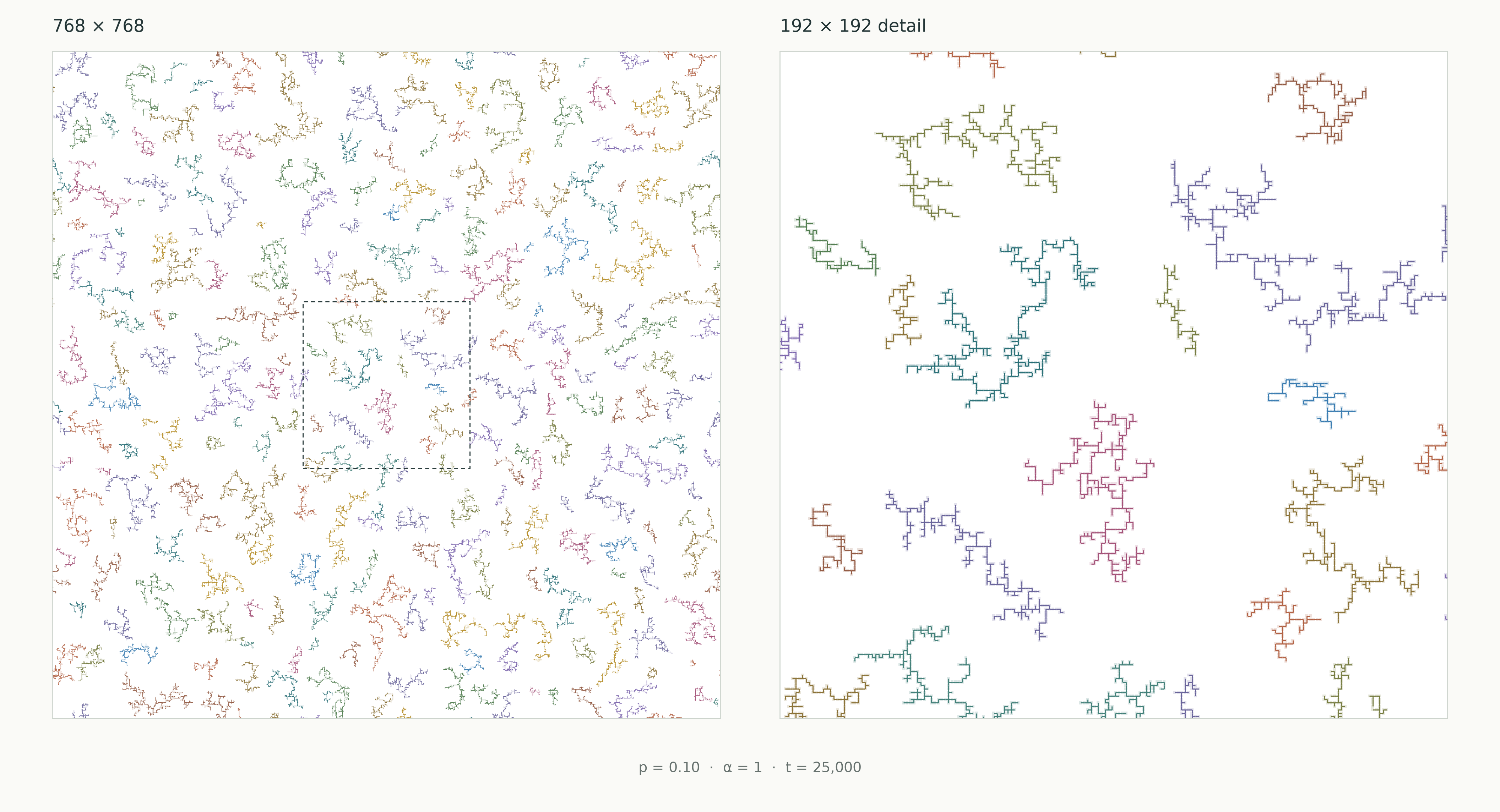
Initially, each lattice site contains one particle with probability , independently. A cluster of particles attempts to move one lattice step at rate , choosing a coordinate direction uniformly. Larger clusters therefore move more slowly when .
If the translated cluster would overlap another cluster, the move is cancelled. Instead, one blocking contact in the chosen direction is selected uniformly, and a bond joins the two clusters. Each collision adds exactly one bond, so every cluster is a tree.
The fully occupied case, , is especially useful: every attempt is blocked, so particles stay at their original sites while their clusters merge.
Set the lattice size, occupancy, and slowdown, then press Start.
Can an infinite cluster form in finite time? Berger, Procaccia, Schmid and Sharon proved that it cannot when , starting from a stationary, ergodic configuration of finite clusters. This includes the entire regime studied here. Their nonexplosion theorem makes it possible to ask the next question: how large are the finite clusters? Finiteness alone does not control their expected size.
A mean-field picture
One way to simplify aggregation is to keep track only of how many clusters have each mass. Let be the number density of mass- clusters. The Smoluchowski coagulation equations are
The first term creates mass by joining smaller clusters; the second removes it through further mergers. The kernel describes how readily masses and meet and stick. See Aldous’s review for the mean-field framework.
A natural well-mixed candidate for our model is : a cluster’s attempt rate is weighted by the amount of material it could encounter. Its scaling suggests a characteristic mass of order . On the lattice, however, encounters also depend on shapes, exposed boundaries, and correlations between neighbours. Turning that prediction into a theorem is the central difficulty.
When does Smoluchowski emerge?
Hammond and Rezakhanlou rigorously connected microscopic aggregation to the spatial Smoluchowski equations, which add diffusion, , to the equation above. They studied Brownian particles carrying mass, with a shrinking interaction range and an increasing particle number in a dilute scaling limit.
Their results cover dimensions three and higher and, with a different logarithmic scaling, dimension two. The limiting densities solve the coagulation–diffusion equations; when the solution is unique, this identifies the limit. The effective collision kernel accounts for the depletion of nearby pairs by earlier collisions.
These results concern Brownian point particles. Our lattice clusters retain their extended shapes after every merger, so a Smoluchowski limit for them requires a separate argument. This comparison helps isolate the question: how much of aggregation can mass alone describe, and when does geometry matter?
How fast do clusters grow?
For the main conjecture, start with one particle at every site. Write for the th moment of the mass of the cluster containing the origin. This samples a cluster through a particle, so larger clusters are more likely to be seen. Higher moments detect rare, unusually large aggregates.
Conjecture. Motivated by the scaling of the Smoluchowski equations, we expect that for every , , and ,
Here means upper and lower bounds by constant multiples, with constants allowed to depend on . The intuition is that a mass- cluster waits roughly between its own attempts; mergers with comparable clusters then suggest . The challenge is that a cluster can also grow by receiving many smaller neighbours.
Current progress. Our full-occupancy bounds give, for every ,
Thus every positive moment grows at most polynomially for every . The lower bound has the conjectured exponent; the upper bound still loses a factor of , and an arbitrarily small additional power.
The upper argument controls how far an aggregate can spread by tracing its merger history. Converting spatial extent into mass introduces the dimension factor. More recent estimates control mass directly for growth transmitted by sources below a fixed size. They give exponential tails for that auxiliary growth, but their dependence on the size cutoff is still too costly to close the conjecture. The missing estimate concerns the correlated influx of small clusters into large receivers.
In dimensions , with vacancies, we also obtain polynomial bounds for all positive moments in a substantial range of . Extending these to every , and finding sharp powers, remain open.
The table collects our current bounds for and ; constants multiplying the bounds are suppressed. With vacancies, is conditioned on the origin being occupied at time .
| Initial occupancy | Dimension | Slowdown range | Lower bound for | Upper bound for |
|---|---|---|---|---|
| Full () | All | , every | ||
| Vacancies () | Polynomial in |
Here , and for . The vacancy upper bound is polynomial, but its exponent is not sharp.
With vacancies, the expected lower growth rate is proved in dimensions two and three. Extending it to every slowdown parameter in dimensions four and higher remains open, although weaker lower bounds are available.
The geometry left behind
At full occupancy, merger bonds accumulate into a limiting spanning forest. Our arguments show that every component is infinite and has only one or two routes to infinity, in the precise sense of tree ends. A simple random walk on each component returns to its starting point almost surely—even in high ambient dimension.
Whether this forest is connected remains open. In two dimensions, we can connect that question to growth: the conjectured first-moment upper bound would force the interfaces between distinct clusters to disappear, and hence imply connectivity. This is one reason sharp moment estimates matter beyond cluster size.
Hover over a cluster to reveal its merger tree. Replay shows how the full-occupancy aggregate forms.
When momentum drives the motion
We also study a model in which particles carry random initial momenta. A cluster of mass and total momentum has velocity . It attempts a step in a coordinate direction at rate , so its mean drift when unblocked is . The collision rule is unchanged, and mergers conserve mass and momentum:
Opposing momenta can cancel on merging, producing slowdown through the dynamics. Each merger also dissipates kinetic energy.
For independent, identically distributed bounded or Gaussian initial velocities, we construct the full-occupancy process on the infinite lattice in every dimension. It is unique within the stationary finite-cluster class with compatible driving randomness, and every positive cluster-size moment stays finite at every finite time. The velocities need not have mean zero.
For initial velocities uniform in the unit ball, we also prove, for every and ,
In two dimensions, the mean cluster size therefore grows at least as . Our upper bounds guarantee finite moments but do not yet give a sharp growth law.
We are continuing to work on the momentum-driven case.
References
- N. Berger, E. B. Procaccia, D. Schmid and D. Sharon. Cluster-Cluster model in (2026). arXiv:2608.05105.
- D. J. Aldous. Deterministic and stochastic models for coalescence (aggregation and coagulation): a review of the mean-field theory for probabilists. Bernoulli 5, 3–48 (1999). Paper.
- A. Hammond and F. Rezakhanlou. The Kinetic Limit of a System of Coagulating Brownian Particles. Archive for Rational Mechanics and Analysis 185, 1–67 (2007). Paper · Open preprint.
- A. Hammond and F. Rezakhanlou. Kinetic Limit for a System of Coagulating Planar Brownian Particles. Journal of Statistical Physics 124, 997–1040 (2006). Paper · Open preprint.
- A. Hammond. Coagulation and diffusion: A probabilistic perspective on the Smoluchowski PDE. Probability Surveys 14, 205–288 (2017). Survey · Open preprint.
The growth, geometry, and momentum results presented as our work above refer to my ongoing thesis notes, rather than to the external papers in this list. Full proofs of these thesis results will be posted soon.